
Semaglutide Research Hub
The most-studied long-acting GLP-1 receptor agonist: mechanism, comparison with tirzepatide, handling, and lab vials from 5 mg to 50 mg.
What is semaglutide?
Semaglutide is a long-acting GLP-1 receptor agonist with two amino-acid substitutions and a C18 fatty diacid chain attached to the lysine at position 26 through a spacer. The fatty chain binds albumin, which extends its half-life to about a week. Its CAS number is 910463-68-2 and its molecular weight is about 4113.6 Da.
It is the most widely studied GLP-1 analog in current metabolic research, used in incretin-signalling, glucose-handling, and appetite-pathway studies, and as the single-receptor comparator for dual and triple agonists. QSC supplies semaglutide strictly for laboratory research.
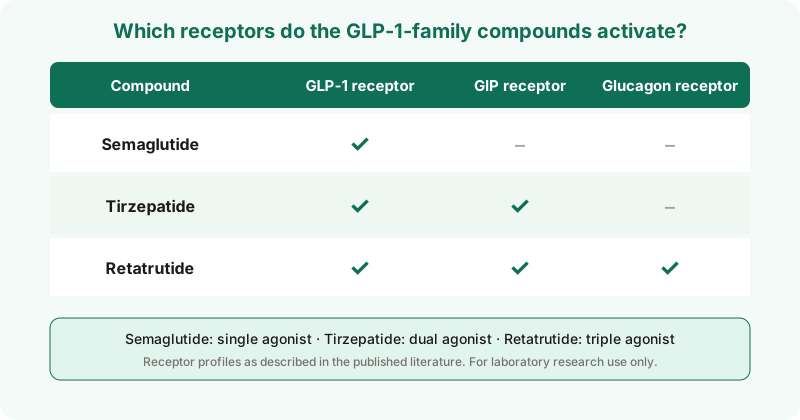
Receptor profiles of semaglutide, tirzepatide and retatrutide as described in the literature.
Start here: research guides
- 7 min readSemaglutide in Metabolic Research: Mechanism, Half-Life, and ReconstitutionA reference overview of the most-studied GLP-1 receptor agonist in current metabolic research.Read article
- 5 min readChoosing a Semaglutide Vial Size: 5 mg to 50 mgHow to pick among seven semaglutide vial sizes: reconstitution at 1 to 3 mg/mL, the roughly eight-week refrigerated window, and cost per milligram.Read article
- 8 min readTirzepatide vs Semaglutide: A Research Comparison of GLP-1 Family AnalogsReceptor profile, pharmacokinetics, and practical considerations for choosing between the two most-studied GLP-1 family peptides.Read article
- 6 min readRetatrutide: A Triple Agonist in Metabolic ResearchWhat separates a glucagon-pathway-inclusive analog from the GLP-1 and GLP-1+GIP compounds it follows.Read article
Lab vials
Semaglutide in seven vial sizes from 5 mg to 50 mg, plus pre-mixed research blends with cagrilintide. All are supplied as lyophilized powder in 10-vial packs.

Semaglutide 5mg — 10-Vial Pack
SG-2511 · 99.1%
$71.92

Semaglutide 10mg — 10-Vial Pack
SG-2511 · 99.1%
$87.92

Semaglutide 15mg — 10-Vial Pack
SG-2511 · 99.1%
$119.92

Semaglutide 20mg — 10-Vial Pack
SG-2511 · 99.1%
$135.92

Semaglutide 30mg — 10-Vial Pack
SG-2511 · 99.1%
$167.92

Semaglutide 40mg — 10-Vial Pack
SG-2511 · 99.1%
$207.92

Semaglutide 50mg — 10-Vial Pack
SG-2511 · 99.1%
$255.92

Cagri + Semaglutide 5mg — 10-Vial Pack
CA-2609 · Blend
$72.92

Cagri + Semaglutide 10mg — 10-Vial Pack
CA-2609 · Blend
$145.92

Cagri + Semaglutide 20mg — 10-Vial Pack
CA-2609 · Blend
$242.92
Semaglutide · Questions
What is semaglutide?
+
Semaglutide is a long-acting GLP-1 receptor agonist: a GLP-1 analog with two amino-acid substitutions and a C18 fatty diacid chain at lysine 26 that binds albumin (CAS 910463-68-2, about 4113.6 Da).
How does semaglutide differ from tirzepatide and retatrutide?
+
Semaglutide is a single agonist of the GLP-1 receptor. Tirzepatide adds GIP-receptor activity, and retatrutide adds both GIP and glucagon-receptor activity. Semaglutide is therefore the standard single-receptor comparator in incretin research.
What is semaglutide studied for?
+
Research areas include incretin signalling, glucose handling, appetite pathways, and comparative studies against dual and triple agonists. It is the most widely studied GLP-1 analog in current metabolic research.
Which semaglutide vial size should I choose?
+
QSC supplies 5, 10, 15, 20, 30, 40 and 50 mg vials. Choose by stock concentration and how quickly you will use the solution. Concentration equals the milligrams in the vial divided by the millilitres of solvent: a 10 mg vial in 5 mL gives 2 mg/mL, and a 50 mg vial in 25 mL gives 2 mg/mL. Check the vial capacity before adding solvent.
How do I reconstitute and store semaglutide?
+
Most in-vitro protocols reconstitute at 1 to 3 mg/mL in sterile bacteriostatic water. Swirl gently rather than shaking. Reconstituted material is typically stable for up to about eight weeks under refrigeration. Keep lyophilized powder at -20°C for long-term storage.
What semaglutide blends are available?
+
Pre-mixed research blends of cagrilintide and semaglutide are available in 5 mg, 10 mg and 20 mg vials. Amylin-pathway and GLP-1-pathway combinations are an active area of metabolic research.
Are prices per vial or per pack?
+
Prices are per 10-vial pack of one size. Email us to arrange a smaller order at the same per-vial price. Orders of $1,000 or more ship free, and delivery is typically about 10 to 15 days, duties paid.
Is semaglutide approved for human use?
+
The research-grade material QSC supplies is not approved for human or veterinary use and is sold strictly for laboratory research. Nothing on this site is medical advice.
Published by QSC Peptidology for research-community reference. Not medical advice, and not a recommendation for human or veterinary use. All products are sold strictly for laboratory and research use only.