
CJC-1295 and Ipamorelin Research Hub
A GHRH analog and a selective ghrelin mimetic: DAC versus no-DAC, why the two are studied together, handling, and lab-ready vials and pre-mixed blends.
What are CJC-1295 and ipamorelin?
CJC-1295 is a synthetic analog of growth hormone releasing hormone (GHRH 1-29) with four amino-acid substitutions that resist enzymatic degradation. It comes in two forms: no-DAC, with a half-life of about 30 minutes, and DAC, which carries a maleimidopropionic-acid linker that binds serum albumin through Cys-34 and extends the half-life to about eight days.
Ipamorelin is a five-residue synthetic pentapeptide that acts as a selective agonist at the ghrelin receptor (GHSR-1a); in published animal studies it shows minimal effect on cortisol, prolactin or ACTH. Because the two act on different receptors on pituitary somatotrophs, the CJC-1295 and ipamorelin pairing is the most widely studied growth-hormone-axis combination. QSC supplies both strictly for laboratory research.
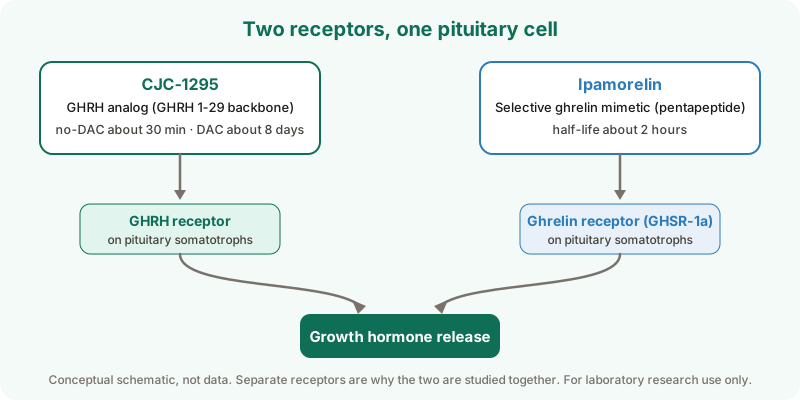
CJC-1295 and ipamorelin act on two different pituitary receptors (conceptual schematic).
Start here: research guides
- 8 min readThe CJC-1295 + Ipamorelin Stack in Growth Hormone ResearchPairing a GHRH analog with a ghrelin mimetic — the standard framework for modern GH-pathway research.Read article
- 6 min readSermorelin, Tesamorelin, and CJC-1295: Comparing GHRH AnalogsThree GHRH analogs with very different half-lives — choosing among them depends entirely on whether your protocol wants pulses or plateaus.Read article
- 7 min readThe GHRP Family: GHRP-2, GHRP-6, and Hexarelin in ResearchOlder-generation ghrelin mimetics, where each one's off-target signaling actually tells you something about ghrelin biology.Read article
Lab vials
Ipamorelin, CJC-1295 in no-DAC and DAC forms, and pre-mixed CJC-1295 + ipamorelin blends, all supplied as lyophilized powder in 10-vial packs.

Ipamorelin 2mg — 10-Vial Pack
IP-2608 · 99.3%
$39.92

Ipamorelin 5mg — 10-Vial Pack
IP-2606 · 99.3%
$64.92

Ipamorelin 10mg — 10-Vial Pack
IP-2607 · 99.3%
$95.92

CJC-1295 no-DAC 5mg — 10-Vial Pack
CJ-2608 · 99.2%
$103.92

CJC-1295 no-DAC 10mg — 10-Vial Pack
CJ-2607 · 99.2%
$169.92

CJC-1295 DAC 2mg — 10-Vial Pack
CJC-2608 · 99.3%
$135.92

CJC-1295 DAC 5mg — 10-Vial Pack
CJC-2608 · 99.3%
$218.92

CJC-1295 DAC 10mg — 10-Vial Pack
CJC-2608 · 99.3%
$395.92

CJC1295 + Ipamorelin 10mg — 10-Vial Pack
CJ-2609 · Blend
$143.92

CJC1295 + Ipamorelin 20mg — 10-Vial Pack
CJ-2609 · Blend
$259.92
CJC-1295 and Ipamorelin · Questions
What is CJC-1295?
+
CJC-1295 is a synthetic analog of growth hormone releasing hormone (GHRH 1-29) with four amino-acid substitutions that resist enzymatic degradation. It is studied as a GHRH-receptor agonist in growth-hormone-axis research and is available with or without the DAC albumin-binding linker.
What is the difference between CJC-1295 DAC and no-DAC?
+
The DAC form has a maleimidopropionic-acid linker that binds serum albumin through Cys-34, extending the half-life to about eight days and supporting continuous receptor activation. The no-DAC form lacks the linker and has a half-life of about 30 minutes, close to native GHRH's short pulse profile, and is used for pulsatile designs.
What is ipamorelin?
+
Ipamorelin is a five-residue synthetic pentapeptide that acts as a selective agonist at the ghrelin receptor (GHSR-1a), with a half-life of about two hours. In published animal studies it shows minimal effect on cortisol, prolactin or ACTH, which is the basis for calling it a selective GH releaser (CAS 170851-70-4, about 711.86 Da).
Why are CJC-1295 and ipamorelin studied together?
+
They act on separate receptors on pituitary somatotrophs, the GHRH receptor and the ghrelin receptor, and research on combined activation reports greater GH release than either alone. Ipamorelin's selectivity lets effects be attributed to GH-pathway activation rather than to other hormone changes, and the pairing has the deepest comparative literature.
Which CJC-1295 form is paired with ipamorelin?
+
It depends on the research question. The no-DAC form is most often paired with ipamorelin in pulse designs because the half-lives are closer. The DAC form is used where continuous GHRH-receptor activation is the variable, and its eight-day half-life then differs widely from ipamorelin's two hours.
How do I reconstitute CJC-1295 and ipamorelin?
+
CJC-1295 is typically reconstituted at 1 to 2 mg/mL and ipamorelin at 2 to 5 mg/mL, in sterile or bacteriostatic water. Concentration equals the milligrams in the vial divided by the millilitres of solvent, so a 5 mg ipamorelin vial in 2 mL gives 2.5 mg/mL. Refrigerate after reconstitution.
What is the pre-mixed CJC-1295 + ipamorelin blend?
+
It is a single-vial research blend of CJC-1295 and ipamorelin, 10 mg or 20 mg total content per vial, for protocols that use both compounds together and prefer one reconstitution step over two. Protocols that keep the two compounds in separate vials can use the single-compound vials instead.
Is a certificate of analysis available?
+
A COA for CJC-1295 no-DAC batch CJ-2608 (99.3% HPLC, measured mass 3368.0 Da against a theoretical 3367.90 Da) is published in the COA library. Reports are provided for batches where one exists.
Are prices per vial or per pack?
+
Prices are per 10-vial pack of one size. Email us to arrange a smaller order at the same per-vial price. Orders of $1,000 or more ship free, and delivery is typically about 10 to 15 days, duties paid.
Are these approved for human use?
+
No. The research-grade material QSC supplies is not approved for human or veterinary use and is sold strictly for laboratory research. Nothing on this site is medical advice.
Published by QSC Peptidology for research-community reference. Not medical advice, and not a recommendation for human or veterinary use. All products are sold strictly for laboratory and research use only.