
AOD-9604 and HGH Fragment 176-191 Research Hub
Two closely related growth-hormone C-terminal peptides, one amino acid apart: how to tell them apart, how they are handled, and lab-ready AOD-9604 vials.
What are AOD-9604 and HGH fragment 176-191?
HGH fragment 176-191 is the unmodified C-terminal stretch of human growth hormone: sixteen residues starting with phenylalanine at position 176, with a disulfide bond between Cys182 and Cys189. AOD-9604 (Anti-Obesity Drug 9604) is the analog developed in the 1990s by Metabolic Pharmaceuticals in Australia, with tyrosine in place of that phenylalanine, written Tyr-hGH(177-191).
The single substitution adds one oxygen atom and moves the mass from about 1799.1 Da to about 1815.1 Da. Published work studies AOD-9604 mainly in lipolysis and adipose-tissue models, and later in joint and cartilage models; the unmodified fragment has been studied far less. QSC supplies AOD-9604 strictly for laboratory research.
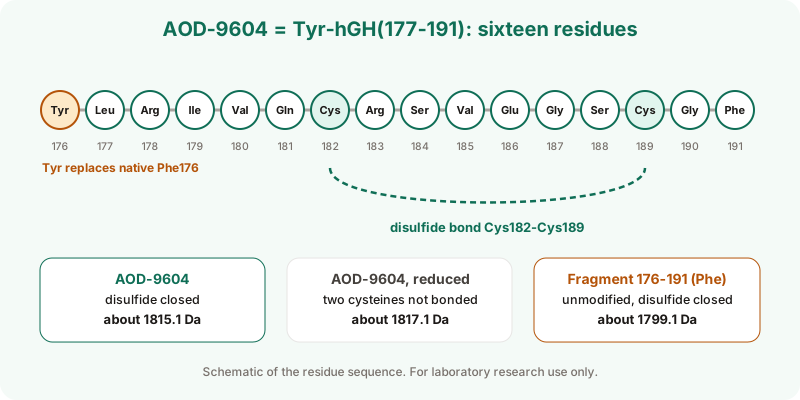
AOD-9604 is Tyr-hGH(177-191): tyrosine in place of the native Phe176 (schematic).
Start here: research guides
- 4 min readAOD-9604: A Modified HGH Fragment in Lipolysis ResearchWhat AOD-9604 is, why it was designed, and what published work does and does not show.Read article
- 5 min readHGH Fragment 176-191 vs AOD-9604: What Is the Difference?One amino acid apart: phenylalanine versus tyrosine at position 176, a 16 Da mass difference, and what to check on a COA.Read article
Lab vials
AOD-9604 in 5 mg and 10 mg vials, supplied as lyophilized powder in 10-vial packs.


AOD-9604 and HGH Fragment 176-191 · Questions
What is AOD-9604?
+
AOD-9604 (Anti-Obesity Drug 9604) is a synthetic sixteen-residue peptide, Tyr-hGH(177-191): the C-terminal region of human growth hormone with tyrosine in place of the native phenylalanine at position 176. Its CAS number is 221231-10-3 and its mass is about 1815.1 Da with the Cys182-Cys189 disulfide closed.
Is HGH fragment 176-191 the same as AOD-9604?
+
No, but they are closely related. They have the same length and the same disulfide bond and differ at one residue: the unmodified fragment 176-191 has phenylalanine at position 176 (CAS 66004-57-7, about 1799.1 Da), while AOD-9604 has tyrosine there (CAS 221231-10-3, about 1815.1 Da). Suppliers sometimes use the names interchangeably, so check the CAS number and measured mass.
Why do 1799, 1815 and 1817 Da all appear in listings?
+
The 16 Da gap separates the two peptides (phenylalanine versus tyrosine). A separate 2 Da gap exists within AOD-9604: about 1815.1 Da with the disulfide bond closed and about 1817.1 Da with both cysteines reduced. A measured mass near 1815 Da indicates the tyrosine form.
What is AOD-9604 studied for?
+
Early rodent studies in obese animals reported increased lipolysis and reduced fat accumulation without a growth-promoting effect, and later work looked at joint and cartilage models. Human weight-loss trials of AOD-9604 did not show a clinically meaningful effect over placebo, so current research is mostly mechanistic and tissue-model based.
Does QSC supply the unmodified HGH fragment 176-191?
+
QSC currently lists AOD-9604, the tyrosine form, in 5 mg and 10 mg vials. Check the CAS number and the measured mass on the COA to confirm which form you have.
How do I reconstitute and store AOD-9604?
+
Reconstitute at 1 to 2 mg/mL in sterile or bacteriostatic water, refrigerate the solution, divide it into single-use aliquots, and avoid repeated freeze-thaw cycles. Keep long-term stock as lyophilized powder at -20°C. The half-life is short.
Is a certificate of analysis available?
+
Yes. The COA for AOD-9604 batch AOD-2608 reports 99.21% HPLC purity and a measured mass of 1815.39 Da against a theoretical 1815.1 Da, and it is published in the COA library.
Are prices per vial or per pack?
+
Prices are per 10-vial pack of one size. Email us to arrange a smaller order at the same per-vial price. Orders of $1,000 or more ship free, and delivery is typically about 10 to 15 days, duties paid.
Is AOD-9604 approved for human use?
+
No. QSC sells AOD-9604 strictly for laboratory research, and nothing on this site is medical advice or a recommendation for use in people or animals.
Published by QSC Peptidology for research-community reference. Not medical advice, and not a recommendation for human or veterinary use. All products are sold strictly for laboratory and research use only.