
Gonadorelin Research Hub
The native-sequence GnRH decapeptide: why exposure pattern matters, how it is handled, and lab-ready 2 mg and 5 mg vials.
What is gonadorelin?
Gonadorelin is the native-sequence gonadotropin-releasing hormone (GnRH, also called LHRH) decapeptide. It stimulates the pituitary to release luteinizing hormone (LH) and follicle-stimulating hormone (FSH), which makes it a standard tool in research on the hypothalamic-pituitary-gonadal (HPG) axis. Its CAS number is 33515-09-2 and its molecular weight is about 1182 Da.
Its plasma half-life is very short, on the order of minutes, so published protocols use pulsatile exposure. Research compares pulsatile versus continuous GnRH exposure and receptor-desensitisation models. QSC supplies gonadorelin strictly for laboratory research.
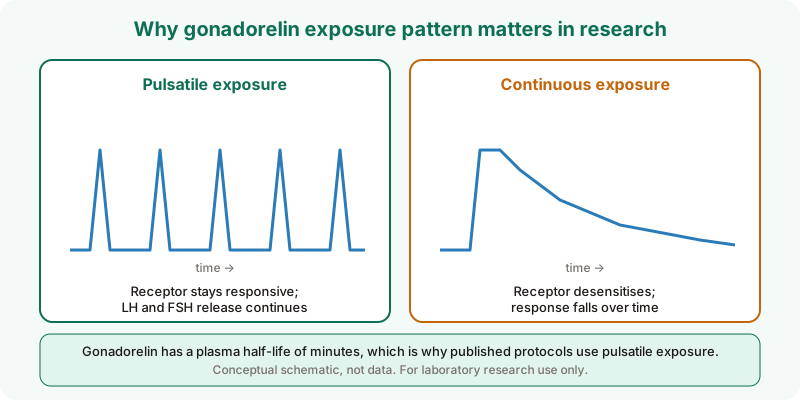
Pulsatile versus continuous GnRH exposure (conceptual schematic, not data).
Lab vials
Gonadorelin in 2 mg and 5 mg vials, supplied as lyophilized powder in 10-vial packs.


Gonadorelin · Questions
What is gonadorelin?
+
Gonadorelin is the native-sequence gonadotropin-releasing hormone (GnRH, LHRH) decapeptide. It stimulates pituitary release of LH and FSH and is used in research on the hypothalamic-pituitary-gonadal axis. CAS 33515-09-2; molecular weight about 1182 Da.
Is gonadorelin the same as GnRH?
+
Yes. Gonadorelin is the name for the native-sequence GnRH decapeptide, so the terms GnRH, LHRH, and gonadorelin refer to the same sequence. Other GnRH analogs have modified sequences and longer half-lives.
Why does pulsatile exposure matter in research?
+
Because the GnRH receptor responds differently to pulses than to sustained exposure. Pulsatile exposure keeps the receptor responsive and LH and FSH release continuing, while continuous exposure leads to receptor desensitisation and a falling response. Gonadorelin's half-life of minutes is why protocols use pulses.
How do I reconstitute gonadorelin?
+
Reconstitute the lyophilized powder in sterile or bacteriostatic water at a concentration suited to your protocol. Concentration equals the milligrams in the vial divided by the millilitres of solvent, so a 5 mg vial in 5 mL gives 1 mg/mL. Swirl gently, and refrigerate after reconstitution.
How should gonadorelin be stored?
+
Keep lyophilized powder at -20°C for long-term storage. Because the peptide is short-lived in solution, divide the reconstituted solution into single-use aliquots, refrigerate, and avoid repeated freeze-thaw cycles.
Should I choose the 2 mg or 5 mg vial?
+
Choose by how quickly you will use the reconstituted solution. The 2 mg vial limits waste in small or slow protocols; the 5 mg vial suits many replicates in a short period. Each 10-vial pack contains ten identical vials from one lot.
Are prices per vial or per pack?
+
Prices are per 10-vial pack of one size. Email us to arrange a smaller order at the same per-vial price. Orders of $1,000 or more ship free, and delivery is typically about 10 to 15 days, duties paid.
Is gonadorelin approved for human use?
+
The research-grade material QSC supplies is not approved for human or veterinary use and is sold strictly for laboratory research. Nothing on this site is medical advice.
Published by QSC Peptidology for research-community reference. Not medical advice, and not a recommendation for human or veterinary use. All products are sold strictly for laboratory and research use only.