
HGH Fragment 176-191 vs AOD-9604: What Is the Difference?
One amino acid apart: phenylalanine versus tyrosine at position 176, a 16 Da mass difference, and what to check on a COA.
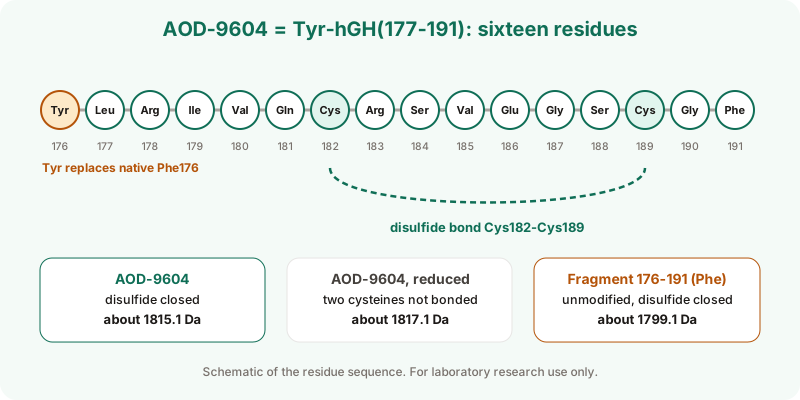
Two names circulate for closely related molecules. HGH fragment 176-191 is the unmodified C-terminal stretch of human growth hormone, sixteen residues beginning with phenylalanine at position 176. AOD-9604 is the analog developed in the 1990s by Metabolic Pharmaceuticals in Australia: the same stretch with a tyrosine in place of that phenylalanine, written Tyr-hGH(177-191).
What is the actual difference?
One amino acid. The two peptides have the same length, the same fifteen residues from 177 to 191, and the same Cys182-Cys189 disulfide bond. AOD-9604 has tyrosine at the N-terminus where the unmodified fragment has phenylalanine, which adds one oxygen atom to the molecule.
That single change moves the mass from about 1799.1 Da (fragment 176-191, CAS 66004-57-7) to about 1815.1 Da (AOD-9604, CAS 221231-10-3), a difference of about 16 Da. AOD-9604 is also the compound that went through formal preclinical and clinical development, so the human trial data in the literature refer to AOD-9604, not to the unmodified fragment.
Why do 1799, 1815 and 1817 Da all appear?
The 16 Da gap separates the two peptides. A separate gap of about 2 Da exists within AOD-9604 itself: with the Cys182-Cys189 disulfide bond closed the theoretical mass is about 1815.1 Da, and with both cysteines reduced it is about 1817.1 Da, because forming a disulfide removes two hydrogen atoms. Suppliers list either value.
When you read a certificate of analysis, compare the measured LC-MS mass with the theoretical mass for the form that was analysed. A measured mass near 1815 Da identifies the tyrosine form (AOD-9604); a mass near 1799 Da would indicate the unmodified phenylalanine fragment. For example, QSC batch AOD-2608 (AOD-9604) reports a measured mass of 1815.39 Da against a theoretical 1815.1 Da, with an HPLC purity of 99.21%; the report is published in the COA library.
What does the published research show?
The rationale is the one described in our AOD-9604 overview: a growth-hormone fragment that keeps lipolytic activity in adipose-tissue models without the IGF-1 stimulation seen with full-length growth hormone. Early rodent studies in obese animals reported increased lipolysis and reduced fat accumulation, without a growth-promoting effect.
Human weight-loss trials of AOD-9604 did not show a clinically meaningful effect over placebo, and later work moved to joint and cartilage models, where the results come from animal and in-vitro studies. The unmodified fragment 176-191 has been studied far less, and lipolytic claims made for it often rest on AOD-9604 data.
Which one should a protocol specify?
If a paper's methods name fragment 176-191 without giving a sequence, check the cited source before substituting AOD-9604, or the reverse. State the compound by CAS number or sequence, the form (disulfide closed or reduced), and the batch ID in your own records, so that results can be compared between labs.
Handling and supply
AOD-9604 has a short half-life. Reconstitute at 1 to 2 mg/mL in sterile or bacteriostatic water, refrigerate the solution, divide it into single-use aliquots, and keep long-term stock as lyophilized powder at -20°C.
QSC currently supplies AOD-9604 in 5 mg and 10 mg vials, in 10-vial packs, for laboratory research use only. Nothing here is medical advice or a recommendation for use in people or animals.

