
GHK-Cu (Copper Peptide) Research Hub
Reference articles, handling guides, and lab-ready vials for the copper tripeptide GHK-Cu, also written Cu-GHK, GHK copper, or copper tripeptide-1.
What is GHK-Cu?
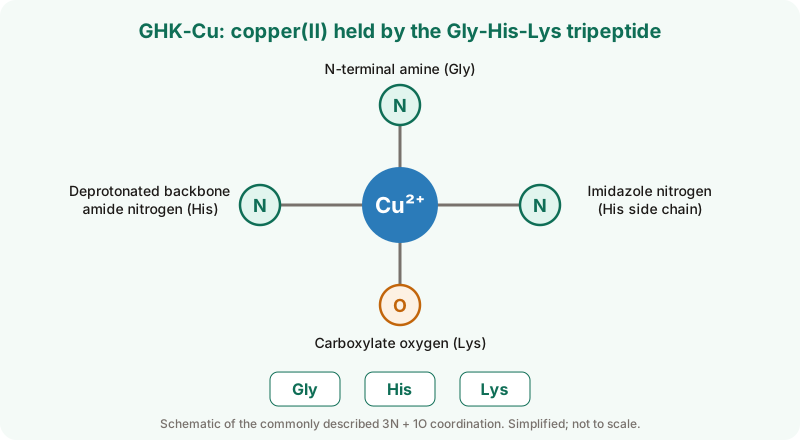
GHK-Cu is the copper(II) complex of the tripeptide glycyl-L-histidyl-L-lysine. It occurs naturally in plasma, saliva, and urine, was first isolated from human plasma in 1973, and is the form used in almost all published copper-peptide research. The copper(II) ion gives it a characteristic blue colour.
Published work studies GHK-Cu in dermal fibroblast cultures, wound-healing and hair-follicle models, and anti-inflammatory and gene-expression assays. Most of the evidence is in-vitro or animal work, and QSC supplies GHK-Cu strictly for laboratory research.
Start here: GHK-Cu research guides
- 7 min readGHK-Cu (Copper Peptide): What It Is, How It Works, and What the Research ShowsA reference overview of glycyl-L-histidyl-L-lysine copper(II): its discovery, proposed mechanisms, research applications, and the limits of the evidence.Read article
- 5 min readWhy Is GHK-Cu Blue? The Chemistry of the Copper Peptide ComplexThe blue colour of GHK-Cu comes from the copper(II) ion bound to the peptide. Here is what that means, and what colour can and cannot tell you about a vial.Read article
- 5 min readHow to Reconstitute and Store GHK-Cu: A Lab Handling GuideSolvent choice, concentration, mixing, storage temperature, and the mistakes that strip copper from the peptide.Read article
- 5 min readGHK-Cu vs AHK-Cu: Comparing Two Copper Tripeptides in ResearchTwo close relatives that differ by a single amino acid, and how researchers choose between them.Read article
- 4 min readGHK-Cu 50mg vs 100mg: Choosing a Vial Size for Your ProtocolHow to match vial size to stock concentration, working volumes, and how fast you will use the solution.Read article
- 6 min readGHK-Cu in Skin and Collagen ResearchThe copper-binding tripeptide that has been studied in fibroblast biology, wound healing, and hair-follicle models for forty years.Read article
GHK-Cu and related copper-peptide vials
GHK-Cu in 50 mg and 100 mg vials, its analog AHK-Cu, and two pre-mixed research blends that include GHK-Cu: GLOW50 (GHK-Cu, BPC-157, TB-500) and KLOW-80 (the same plus KPV). All are supplied as lyophilized powder in 10-vial packs.

GHK-Cu 50mg — 10-Vial Pack
GHK-2607 · 99.1%
$55.92

GHK-Cu 100mg — 10-Vial Pack
GHK-2607 · 99.1%
$103.92

AHK-Cu 50mg — 10-Vial Pack
AH-2608 · 99.0%
$111.92

AHK-Cu 100mg — 10-Vial Pack
AH-2608 · 99.0%
$167.92

GLOW50 Skin & Hair Blend 70mg — 10-Vial Pack
GL5-2608 · 99.0%+
$287.92

Klow-80 Skin & Beauty Blend 80mg — 10-Vial Pack
KL8-2608 · 99.0%+
$335.92
GHK-Cu questions
What is GHK-Cu?
+
GHK-Cu is the copper(II) complex of the tripeptide glycyl-L-histidyl-L-lysine (Gly-His-Lys). It occurs naturally in plasma, saliva, and urine, was first isolated from human plasma in 1973, and is the form used in nearly all published copper-peptide research. Its CAS number is 89030-95-5 and its molecular weight is about 403 Da.
Is GHK-Cu the same as copper peptide?
+
GHK-Cu is the best-known copper peptide, and the terms are often used interchangeably, but copper peptide is a broader label that also covers analogs such as AHK-Cu. In cosmetic ingredient lists GHK-Cu appears as copper tripeptide-1.
Why is GHK-Cu blue?
+
The colour comes from the copper(II) ion held by the peptide. Copper(II) complexes absorb orange-red light at roughly 600 to 650 nm, so the transmitted light looks blue. The GHK peptide without copper is colourless. Colour confirms copper is present but is not a purity test: only HPLC, mass spectrometry, and copper-content analysis confirm identity and purity.
How do I reconstitute GHK-Cu?
+
A typical stock is 5 to 10 mg/mL in sterile water or bacteriostatic water. Concentration equals the milligrams in the vial divided by the millilitres of solvent, so a 50 mg vial in 5 mL gives 10 mg/mL. Add solvent slowly, swirl gently rather than shaking, and avoid acidic diluents (below about pH 4) and strong chelators such as EDTA, which can strip copper from the peptide.
How should GHK-Cu be stored?
+
Keep lyophilized powder at -20°C for long-term storage, or at 2-8°C for near-term use, protected from light. After reconstitution, refrigerate at 2-8°C and plan to use the solution within several weeks. Divide stock into single-use aliquots and avoid repeated freeze-thaw cycles.
What is the difference between GHK-Cu and AHK-Cu?
+
Both are copper(II) complexes of tripeptides that share histidine and lysine. GHK-Cu starts with glycine; AHK-Cu starts with alanine. GHK-Cu has a much larger published literature, while AHK-Cu is a synthetic analog used mainly in comparative and hair-follicle studies.
Should I choose the 50 mg or 100 mg GHK-Cu vial?
+
Choose by how quickly you will use the reconstituted solution. Reconstituted GHK-Cu is generally usable for several weeks refrigerated, so slow, small-volume work suits the 50 mg vial, while many replicates in a short period suit the 100 mg vial, which also costs less per milligram. Each 10-vial pack contains ten identical vials from one lot.
Is GHK-Cu approved for human use?
+
No. QSC sells GHK-Cu strictly for laboratory research. It is not an approved drug, and nothing on this site is medical advice or a recommendation for use in people or animals. Most published GHK-Cu evidence is in-vitro or animal work.
Published by QSC Peptidology for research-community reference. Not medical advice, and not a recommendation for human or veterinary use. All products are sold strictly for laboratory and research use only.