
How to Reconstitute and Store GHK-Cu: A Lab Handling Guide
Solvent choice, concentration, mixing, storage temperature, and the mistakes that strip copper from the peptide.
GHK-Cu is supplied as a lyophilized copper-peptide complex. It is straightforward to reconstitute, but a few choices, mainly solvent pH and mixing, decide whether the copper stays on the peptide. This guide covers the handling steps used in most published protocols; always follow your own protocol and your lab's safety rules. GHK-Cu is for laboratory research only.
Which solvent should I use?
Sterile water for injection is the standard diluent, with bacteriostatic water (0.9% benzyl alcohol) a good choice when a vial will be punctured more than once. Phosphate-buffered saline near pH 7.0 to 7.4 also works for assays that need a buffered stock.
Avoid acidic diluents. Acetic acid diluent and other solutions below about pH 4 can strip copper from the peptide and the blue colour will fade. Avoid strong chelators such as EDTA for the same reason.
What concentration should I make?
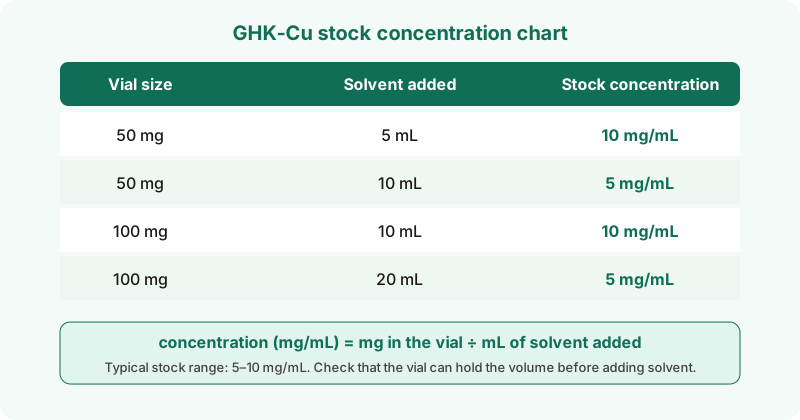
A typical stock is 5 to 10 mg/mL. The arithmetic is simple: concentration equals the milligrams in the vial divided by the millilitres of solvent you add. A 50 mg vial reconstituted with 5 mL gives 10 mg/mL, and with 10 mL gives 5 mg/mL. A 100 mg vial with 10 mL gives 10 mg/mL.
Before adding solvent, confirm that your vial can hold the volume you need. If it cannot, use a higher concentration or transfer the solution to a larger sterile container. Our reconstitution calculator, under Tools, does the arithmetic for any vial size.
How should I mix it?
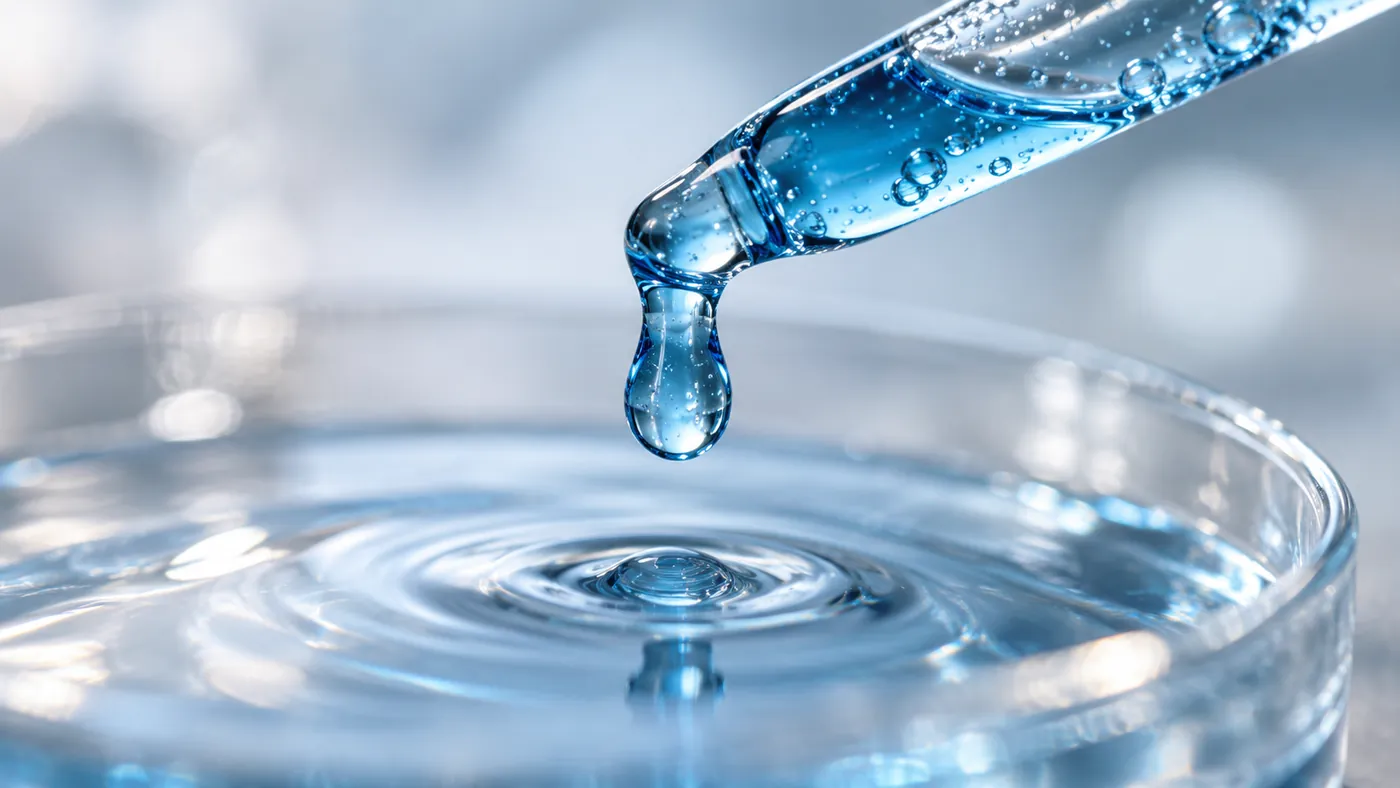
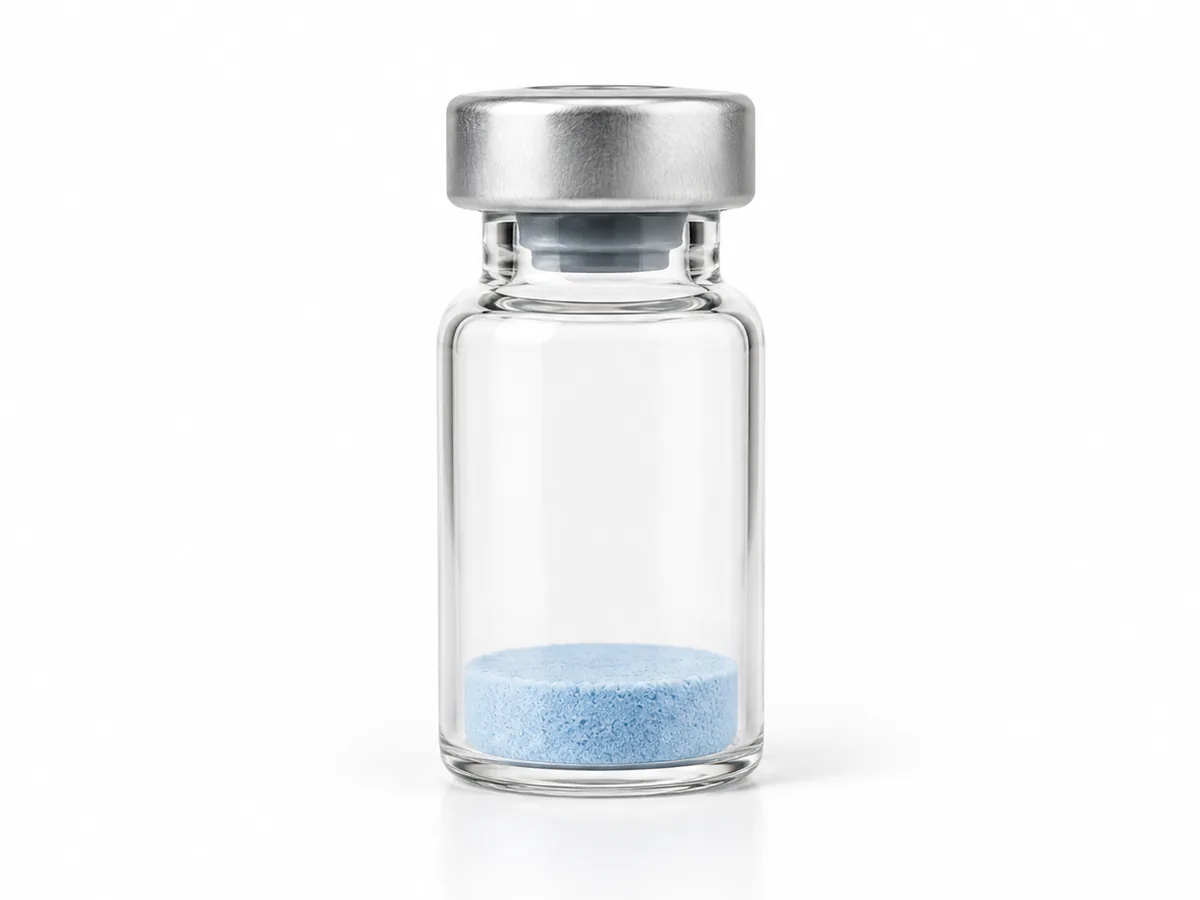
Add the solvent slowly down the inside wall of the vial and let the cake dissolve, then swirl gently. Avoid vigorous shaking, which introduces bubbles and can affect the solution. The solution should be a clear, uniform blue. A solution that is cloudy, has particles, or is green or brown should not be used.
How should I store GHK-Cu?
Keep lyophilized powder at -20°C for long-term storage, or at 2-8°C for near-term use, protected from light. After reconstitution, refrigerate at 2-8°C in the original or an opaque container. Reconstituted GHK-Cu is generally usable for several weeks refrigerated; plan to use it within that window.
To limit repeated handling, divide the stock into single-use aliquots. If you freeze aliquots, avoid repeated freeze-thaw cycles. Label every container with the concentration and the date of reconstitution.
Common mistakes
The most common are using an acidic diluent, mixing by shaking, storing reconstituted solution at room temperature, puncturing a sterile-water vial repeatedly, and skipping the date label. Each has a simple fix: use sterile or bacteriostatic water, swirl, refrigerate, use bacteriostatic water for multi-use vials, and label everything.
QSC supplies GHK-Cu in 10-vial packs of 50 mg and 100 mg vials, and both sterile water and bacteriostatic water in 3 mL and 10 mL 10-packs. For why the solution is blue, and what a colour change means, see our article on GHK-Cu colour chemistry.


