
Why Is GHK-Cu Blue? The Chemistry of the Copper Peptide Complex
The blue colour of GHK-Cu comes from the copper(II) ion bound to the peptide. Here is what that means, and what colour can and cannot tell you about a vial.
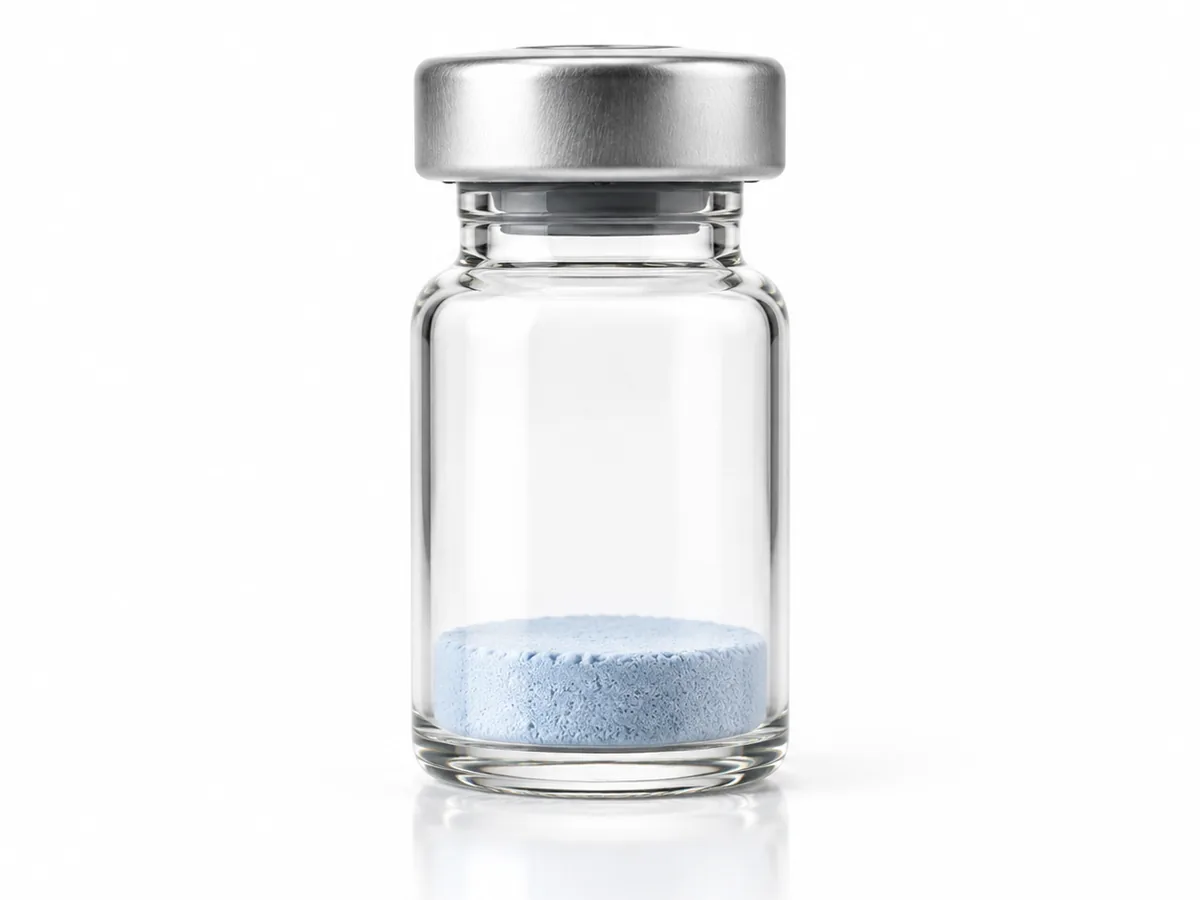
GHK-Cu is blue because of the copper(II) ion held by the peptide. The tripeptide GHK on its own is colourless; it is the copper(II) complex that carries the colour. A lyophilized cake of GHK-Cu typically looks light blue, and a reconstituted solution looks a deeper blue.
What makes copper(II) complexes blue?
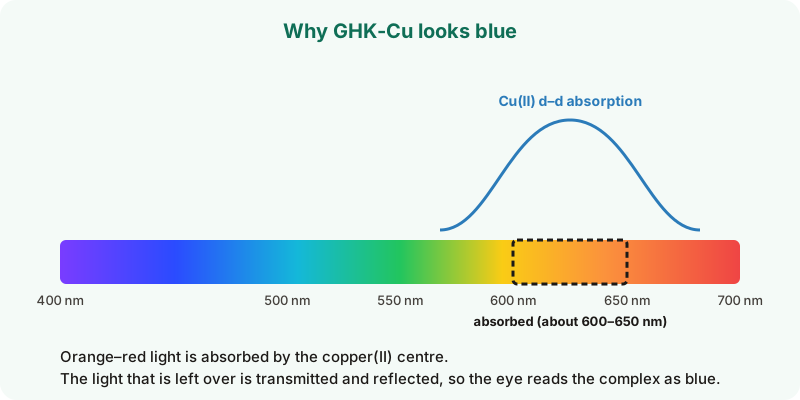
Copper(II) has nine d-electrons, and in a peptide complex the d-orbitals split in energy. Electrons can jump between these levels by absorbing light, and for copper(II) complexes like this one the absorption falls in the red-to-orange part of the visible spectrum, roughly in the 600 to 650 nm range. A material that absorbs red and orange light transmits and reflects the remainder, which the eye reads as blue.
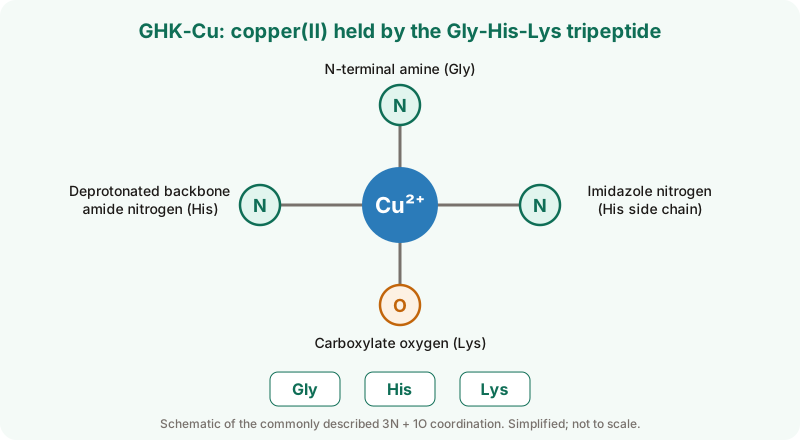
In GHK-Cu the copper(II) ion is typically described as coordinated by nitrogen atoms from the N-terminal amine, the histidine imidazole ring, and a deprotonated backbone amide, with an additional oxygen donor. This tight, planar arrangement is why the complex is stable near neutral pH and why the colour is characteristic.
Why does the colour vary between vials?
Colour intensity depends on how much of the complex is present and how it is packed. A thin lyophilized film looks pale; a dense cake looks more vivid. Concentration matters in solution: a 10 mg/mL solution is visibly deeper blue than a 1 mg/mL solution. Differences in intensity between vials of the same product are therefore not, on their own, a sign of a problem.
What colour can tell you, and what it cannot
Colour is a useful first check. A vial labelled GHK-Cu that contains white or colourless powder suggests the copper complex is absent, which would be an identity problem. A solution that fades, or turns green, brown, or cloudy, can indicate that copper has dissociated from the peptide or that the material has oxidised, and is a reason to stop and reassess.
But colour is not a purity or identity test. Plenty of copper salts, including copper sulfate, are also blue. Only HPLC, mass spectrometry, and copper-content analysis confirm that a blue powder is the right peptide at the right purity.
What makes the blue fade?
The complex is stable near physiological pH, roughly 6.5 to 7.5. Strongly acidic conditions, below about pH 4, can pull copper off the peptide, and the blue fades. Strong chelators such as EDTA can do the same. This is why acidic diluents, including acetic acid diluent, are not suitable for GHK-Cu, and why buffer choice matters in chelation-sensitive assays.
Handling notes
QSC supplies GHK-Cu as the pre-formed copper complex in 10-vial packs of 50 mg and 100 mg vials. Store lyophilized material at -20°C for the long term, or at 2-8°C for near-term use, protected from light. For step-by-step reconstitution and storage, see our GHK-Cu reconstitution and storage guide.

